Guilty Gear Strive 2.0 Battle Balance Patch Is Out And Its Massive

author
Gundroog
19 min

This material was created with the support of our Patrons. You can support us!

Become a Patron
Guilty Gear Strive 2.0 Battle Balance Patch Is Out And Its Massive
NERF NUKE INCOMING

Arc System Works actually did the unthinkable, the impossible, and unimaginable. They made a fighting patch in the current year that dials things back a bit and introduces some general changes that give characters more universal foundation without harming their identity.

Not only that, but they actually go in detail about their reasoning for both overarching game changes and individual character adjustments. Only time will tell how this all pans out, but this is looking like a definitive improvement and puts the game in a much better place than where it was before.

We will include some of the developers general notes, but the volume of changes is so drastic that you should absolutely check out the official website to see per character info.
Overall Balance Direction

Across the past updates, there has been a steady expansion of offensive options and potential combos, meaning that more situations could cause a single hit or counter hit to lead into heavy damage. As a result, this made it often the case where a single interaction could largely determine the rest of the developments in the match.

In Version 2.00, we aim to adjust the battle balance by reevaluating offense and defense to strike a better balance between risk and reward. These adjustments do not aim simply to tone down damage, but to make it clear what actions will have a greater effect in different situations, creating a flow of battle where players can gradually turn the tides to their advantage over multiple interactions.

For these reasons, the adjustments include many changes that make it more challenging to gain major rewards from actions. This includes increasing damage proration, consolidating of startup frames, adjusting the state after invincible moves, limiting the return on Roman Cancel, and more.

As a result, the changes may seem more restrictive than before from both a game mechanic and character perspective. The intention is to prevent the baseline from rising further, creating a clear standard for future battle balance.

We expect that the overall flow of battle going forward will take shape with the balance of risk and reward established in this version as the core.

Combos

We have re-assessed the ease of converting into combos.

Previously, it was common to see long-ranged pokes as well as overheads and lows lead into combos dealing heavy damage. With this adjustment, we have limited the reward possible so that the value of the hit corresponds to the situation.

On the other hand, we have ensured that combos requiring taking risks or making preparations to land will be suitably rewarding, such as actions that require you to enter close range, set up projectiles, use character-unique gauges, or spend Tension gauge.

Our intention is not to make combos themselves weaker, but rather to make it clear what kind of situations can lead to major benefits.

Removing Wild Assault

In Season 3, we added Wild Assault with the goal of creating a new way to use the Burst Gauge and to expand offensive options.

Our original intent was to make it an attack that felt intuitive to use. Over the course of adjusting the mechanic, however, its use cases expanded. While this did create depth to the mechanic, it changed into something that required practice and knowledge to use to its full potential.

As a result, it functioned as a powerful option in battle, but it would lead to greatly different results depending on how precisely it was utilized. Combined with its powerful potential to extend offense, it would create situations that were very challenging for the defender to handle.

In alignment with our intention to emphasize a clear shift between offense and defense in the battle balance, we decided to remove Wild Assault from this version after re-evaluating its place in the game.

Counter Blitz

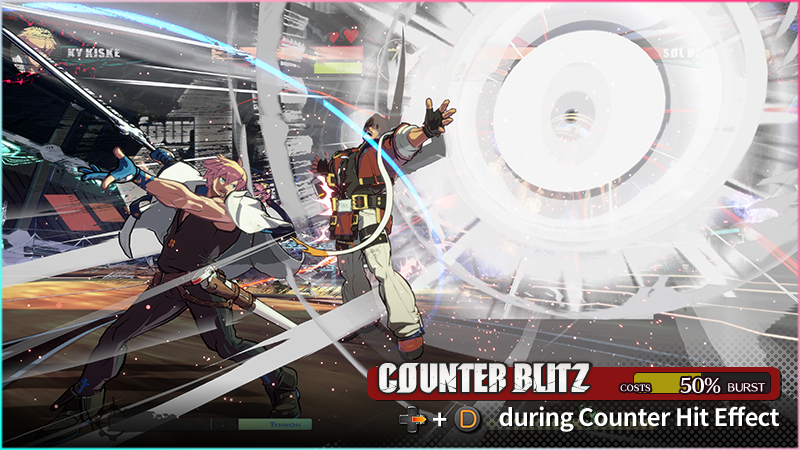
We have added Counter Blitz as a new way to utilize the Burst gauge.

This can be activated during the slow-down effect after a counter hit at the cost of 50% of the Burst gauge. It performs a unique attack.

If the final hit of the attack hits when the opponent is near the corner, it triggers Wall Break.

This does not trigger from counter hits of jabs such as Punch or Kick, special moves, or any normals that cannot be canceled.

This mechanic is tied directly to a counter hit as the trigger, making it an intuitive way to continue your attack.

While easy to start using at any play level, it also is not something that absolutely needs to be incorporated into your play.

We also expect it to provide more factors to weigh for players who value battle strategy and management of the Burst gauge.

It will serve as a means of rewarding decision making based on the situation, rather than one-sidedly making offense stronger.

Damage State Hurtboxes

We have revised the hurtboxes of all characters when they are in the damage state or blocking.

Previously, due to the differing hurtboxes between characters, some combos were only possible on certain characters, or could connect unexpectedly under certain conditions. This made for unstable combos that could not be consistently recreated.

With these changes, we have adjusted the standard for hurtboxes with the intention of making it clear when combos will succeed. There are two standard hurtbox sizes, with all hurtboxes functioning the same in each category.

Large hurtbox: Potemkin, Faust, Nagoriyuki, Goldlewis, Bedman?

Standard hurtbox: All other characters

This addresses the significant difference in possible combos for only certain characters, making for clearer decision making when it comes to combos.

On the other hand, this does mean that combos previously possible only under certain conditions may no longer work. This change prioritizes the stability and reproducibility of combos.

We have made the same adjustments to the hurtboxes when performing actions such as dashing, backdashing, or air dashing, in addition to blocking and taking damage.

Hitboxes

We have added new attack hitboxes that only hit when the opponent is taking damage or blocking (hereon referred to as “follow-up hitboxes”).

Previously in order to stabilize combos we would sometimes need to improve the hitboxes of the attacks themselves, but this could have an effect on the move’s properties as a poke in neutral or as an anti-air as well.

With this adjustment, we have added follow-up hitboxes to certain moves that only activate when the opponent takes damage or blocks. The aim is to have a way to improve the stability of combos while minimizing the effect on neutral. This makes the conditions for combos and strings clear, without making major changes to moves’ properties in neutral.

For Close Slash, we have changed part of the high altitude hitboxes to follow-up hitboxes.

This makes it harder to use Close Slash as an anti-air.

Close Slash had different anti-air potential for each character, and it resulted in very high reward upon a successful anti-air. This adjustment helps it match the intended role of the move.

Psych Burst and Deflect Shield Commands

We have revised the command inputs for Psych Burst and Deflect Shield.

Previously, Deflect Shield would sometimes activate unintentionally when attempting to perform a Throw.

This change aims to prevent accidental inputs, making the intent behind the input clear.

Psych Burst: D+S or D+HS

Deflect Shield: ←+D+P or ←+D+K (direction can be ↙ or ↖)

Setting clearly distinct commands also makes it more consistent to input when a fast reaction is required.

We are also aware that players used to the original controls will need to adjust their sense for the inputs. We have decided on this change out of consideration for the button placement on various controllers and how it could interact with defensive actions.

We will keep track of the changes in the actual match environment as we consider future battle balance adjustments.

Gold Psych Burst

We have revised the input buffer upon wakeup so that Blue Psych Burst will not activate if the input is performed within 4 frames directly before wakeup.

If you input Psych Burst during this time window, you will perform a Gold Psych Burst directly upon wakeup.

This change makes it more consistent to perform a Gold Psych Burst as an option on wakeup.

On the other hand, we have decreased the knockback distance of Psych Burst on block, regardless of the situation during activation. This creates less distance with the opponent, making it more likely for the offensive and defensive turns to switch.

These adjustments intend to make it more consistent to perform, without greatly increasing the benefit. This follows a more defined balance of risk and reward when it comes to the offensive and defensive sides using Psych Burst.

Purple Roman Cancel

Purple Roman Cancel works as a way to create advantageous situations while limiting the opponent’s ability to punish you. However, it made it possible to deal extremely high damage upon a successful read from an advantageous situation, forcing the defending player to make highly risky choices.

We have adjusted it so that when Purple Roman Cancel is used while the opponent is not taking damage, damage proration is applied for a set duration afterwards.

This proration does not apply in situations where the opponent is already taking damage, such as during combos.

This limits the damage possible when using Purple Roman Cancel to set up frame traps or mixup, but it still functions as a means to create an advantageous situation as it did before.

Throw Offense And Defense

When used with Tension gauge accumulated, Throw was not only an effective defensive option, but also could create situations where the opponent is forced to deal with your offense as it could be made safe with Purple Roman Cancel.

These adjustments now make it impossible to Roman Cancel a Throw on whiff, to introduce risk for the player using the Throw.

This makes a clearer division for when offensive and defensive turns switch.

Throw tech also had a very brief time from activation until it was possible to move again at very close range, making it challenging to assess the situation after a throw tech.

We have extended the screen freeze and added distance after the tech to create a better reset to neutral.

In addition to these changes, command grabs no longer have throw invincibility. Previously, their throw invincibility made them function as frame traps as well.

As with normal throws, they can no longer be covered with Purple Roman Cancel on whiff.

Actions with Invincibility

We have re-assessed the risk and reward of various actions with invincibility.

For invincible special moves, we have adjusted the situation on hit and block, while maintaining their role as reversals.

We have adjusted the blowback and recovery of invincible moves that could lead into okizeme on hit, so that they now return you to neutral.

They are also now easier to punish when blocked.

We have also adjusted the mechanics for invincible Overdrives.

They cannot be Roman Canceled, like invincible special moves, and leave you vulnerable to counter hits during the recovery.

They can now no longer be Roman Canceled on hit, making it challenging to deal major damage after an invincible move.

Backdash is also a type of invincible action, so it can no longer be Roman Canceled.

Previously, some strings used Blue Roman Cancel after backdash. We have made it no longer possible to Roman Cancel to manage situations where using invincibility to evade attacks could lead to high rewards.

Faultless Defense

We have revised the input mechanics for Faultless Defense.

Previously, inputting 2 attack buttons simultaneously when you had no Tension gauge would perform an unintended normal move instead of Faultless Defense.

With these adjustments, inputting Faultless Defense will now result in the blocking animation, even when you have no Tension gauge.

When you have no Tension gauge, it will not result in the additional knockback and chip damage nullification unique to Faultless Defense.

In certain instances where activation could be delayed using Faultless Defense, such as the forced end of Nagoriyuki’s Blood Rage and A.B.A’s Jealous Rage, the mechanics have been adjusted so they can no longer be delayed.

Wall Break and Positive Bonus

Previously, it was possible for characters with powerful mixup to maintain their offense in a way that was very challenging to handle for the defender after triggering wall stick when the defender was taking damage on the ground.

We have made adjustments so that even if wall stick is triggered with grounded damage, they perform a tech the same as if the wall stick was triggered with aerial damage.

We have also revised the mechanics for Positive Bonus.

There is a penalty making players gain less Tension gauge for a set duration after using an Overdrive or Roman Cancel. Previously, this penalty duration was shortened during Positive Bonus. The shortened duration no longer applies as of this adjustment.

This means that the penalty to Tension gauge gain now applies as normal after the affected actions, even during Positive Bonus.

This makes the move chosen to trigger Wall Break an important decision when looking to gain Tension gauge.

Low-Profile Moves

Previously, some Crouching Kick attacks could be used to evade attacks due to the low-profile stance they triggered. This created great variation in characters’ abilities to intercept certain strings.

As of this adjustment, the Crouching Kick attacks with low-profile have had their hitboxes extended upward so that they no longer count as low-profile.

We have also revised the damage dealt by attacks that move forward while in a low-profile stance, as they provided high benefit at low risk.

In addition to heavy damage proration, they now have added combo blowback proration to make it harder to extend combos.

These changes aim to even out the outlier situations created by the difference in the characters’ stances.

Damage Proration

We have re-evaluated damage proration for moves that are easy to connect with and can begin combos.

Previously, it was possible to deal major damage from moves that are relatively easy to hit with.
With these changes, we have set high damage proration for such moves to limit the benefit from them.

This applies to the following types of normal and special moves:

  • Lunging special moves
  • Overhead special moves
  • Projectiles
  • Standing Punch, Crouching Punch
  • Low profile lunging moves

Moves with Fast Startup

Previously, there was a difference in the startup speed of the fastest attack for different characters. There was a great difference between characters with a 4 frame startup move and those without when it came to punishing or interrupting the opponent successfully.

In order to align the conditions for success in these situations, we have set the fastest move for all characters to 5 frames.

Aligning the startup frames creates a clearer baseline for decision making when it comes to punishing and interrupting.

→+P Hurtboxes

We have revised the timing when →+P enters a low-profile stance.

Previously, different characters’ →+P attacks would enter a low-profile stance at different frames. This meant that only some characters could interrupt certain strings.

We have made adjustments to unify these conditions, making it so that all characters start with a slightly reduced upper hurtbox as of frame 1, and the hurtbox shrinks to its smallest size at frame 4.

This makes your ability to interrupt strings less dependent on the character.

Damage Rates on counter hit

Previously, damage would increase by 10% upon counter hit.

This would further increase by 20% when the R.I.S.C. Level was at max, and could lead to extremely high damage in certain situations when combined with the lowered defenses.

With these adjustments, we have removed the damage modifier upon counter hit. This limits the upper potential of combos starting from counter hits.

counter hits still trigger the slow-down effect, meaning they still provide benefit in turns of hit confirming and choosing your next attack.

This change aims to make it still valuable to hit, while keeping the potential damage within an appropriate range.

Charge Commands

We have re-evaluated the conditions for successful charge commands.

Previously, charge commands required 30 frames of charge time. We have adjusted it so that they require 25 frames instead.

This makes it easier to perform charge moves after a single poke or an action using a → input, with smoother controls.

This material was created with the support of our Patrons. You can support us!

Become a Patron
0

Share: