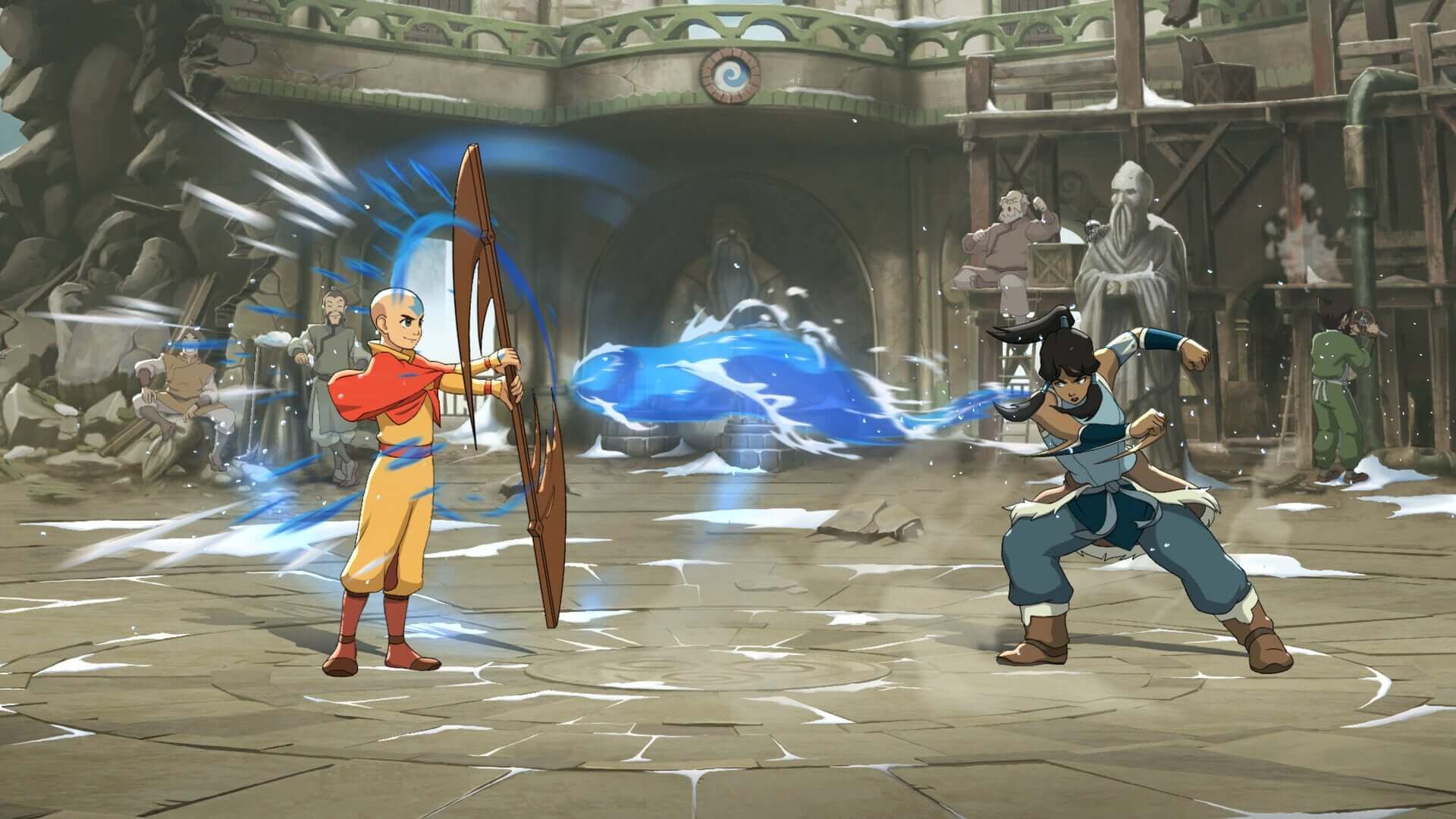
The Avatar fighting game looks surprisingly promising, but only time will tell.
Avatar Legends: The Fighting Game is still fairly early into development. Early enough that the game doesn't even have a release date, which is something that publishers try to nail down well in advance. However, it seems like developers are more than confident enough to show their game off, even in this early state.
Perhaps there is more to come later, but for now, we know that Diaphone and jmcrofts already got to play the game against the devs, and were allowed to show their footage and share their experience.
Diaphone's video puts a major focus on providing everyone with a comprehensive introduction to what this game is. As developers themselves have said before, Avatar Legends: The Fighting Game has a fairly simple control scheme with just 4 buttons – Light, Medium, Heavy, and Flow Stance. While the first 3 are self-explanatory, the last one is fairly unique. Flow Stance acts almost as a dedicated movement button that gives each character access to special movement options and auto-parry stance. In Aang's case, this includes zooming around on the air ball or gliding around with the use of his staff, just as a few examples.
Despite this simple layout, the game still does use motion inputs, and adds more complexity through support characters, which Diaphone aptly compared to MK variations. For the most part, choosing different supports is meant to buff or augment certain parts of the character's toolkit and enable different playstyles. If you're more into anime fighters, imagine the Melty Blood moon system if it focused on more specific parts of the kit.
Past that, the only additional layer of complexity lies within resources. Avatar Legends uses a somewhat unorthodox approach where you have a Drive Gauge type system that is used for movement (although it's much more generous), and chakra points that act as your EX/Super meter that can trigger additional things, like entering Avatar state for Aang.
During his time with the game, Diaphone noticed that anti-airs are surprisingly bad at the moment, leading to situations where it's better to take the jump-in and try to punish it or take your turn after blocking, instead of trying to beat the jump-in entirely.
In general, it seems like within this limited experience, the game's very robust movement seemingly favored more defense oriented playstyles and turtling. Since the game is still in roughly pre-alpha state and uses many placeholder assets, it's safe to say that this is not going to be representative of the final version, but it might already serve as something that developers should look into. This is somewhat reminiscent of the 2XKO closed beta, where many players complained about the combination of movement and large health pools leading to extremely passive matches, something that still occur in certain matchups.
JMCrofts also offered his perspective on things, mainly focusing on why he thinks this is a very refreshing offering compared to other modern fighting games.
Perhaps the most notable thing about Avatar Legends: The Fighting Game is how advanced and free the movement is in this game. This is not something that you see in many modern games. Usually there's an opposite complaint of games becoming slower, more sluggish, or more limiting, but Avatar Legends clearly wants it to be a prominent core mechanic. While it can lead to issues, as me mentioned, it's nothing that developers can't account for with other balancing decisions.
He also points out another valid point – amid a sudden surge of tag and assist fighters, Avatar Legends is more or less a traditional 1v1 fighting game. It stands to cover a distinct position in the current landscape of fighting games. Something that's not as crazy as an all out VS fighter, but also far more free and loose than more grounded fighting games. The same applies to the controls scheme. While many new fighters are going for simple one button specials, Avatar Legends still offers motion inputs. Despite that, it still should be fairly accessible to new players simply thanks to the range of things that you can do without needing motion inputs.
The impressions conclude with him pointing out another distinct feature of the game – the supports. Even more so than Diaphone, jmcrofts puts heavy emphasis on how much these supports can alter how you actually play the game. It's hard to tell what sort of budget the team is working here, but it's obviously not comparable to mastodons like Bandai Namco or Capcom, so this system should really help to add more variety even if the game comes out with a relatively modest roster.

 T8
T8 MK1
MK1 SF6
SF6 GBVSR
GBVSR 2XKO
2XKO SSBU
SSBU T7
T7 DBFZ
DBFZ BH
BH GGST
GGST SC6
SC6 SG2E
SG2E KI
KI MVS
MVS KoFXV
KoFXV MBTL
MBTL SF5
SF5 MK11
MK11